


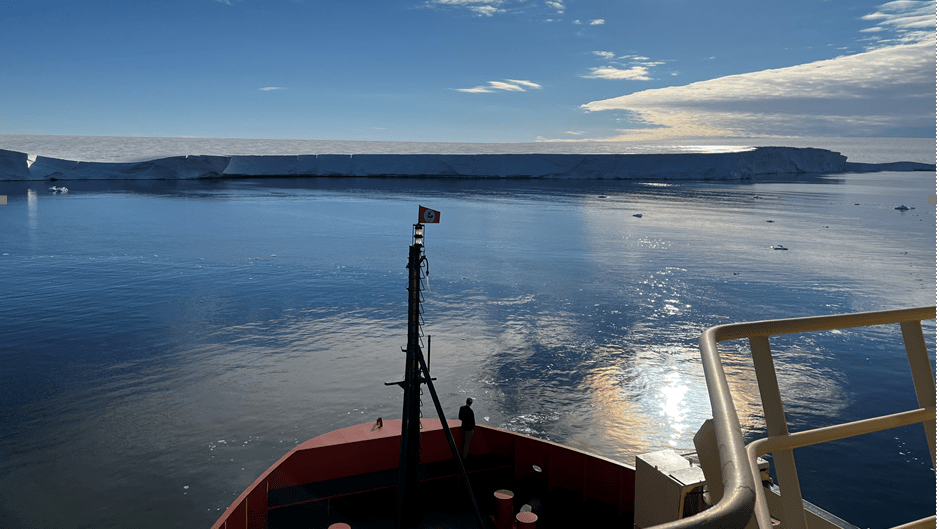
Photos from the 2022 cruise to the Amundsen Sea on the RV Nathaniel B. Palmer. Left: Retrieval of a sediment core on deck. Right: View of the Dotson Ice Shelf from the bridge.
Amundsen Sea Sediment Biogeochemistry
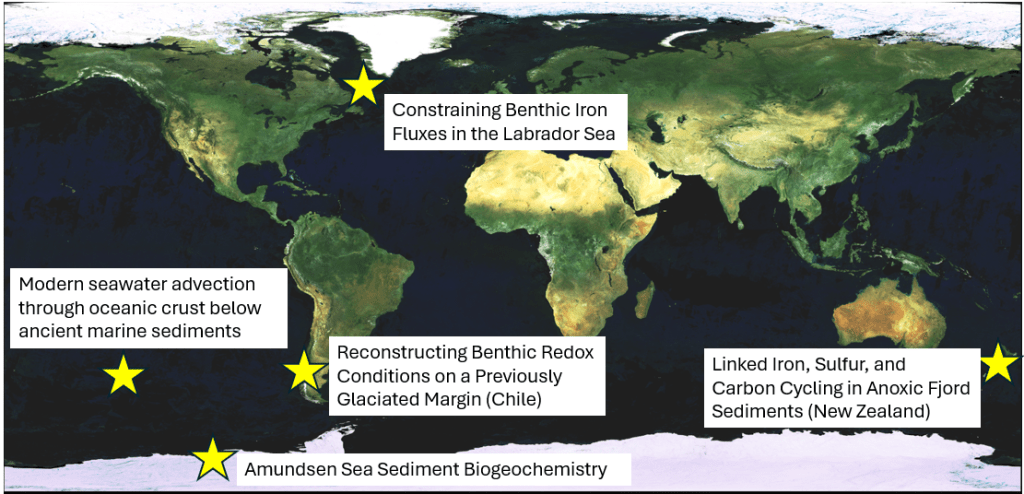
The Amundsen Sea Polynya has the highest rates of primary production of all Antarctic polynyas, and is also proximal to the fastest melting glaciers on the continent, such as the Thwaites and Pine Island glaciers. Prior research has indicated that productivity in the Amundsen Sea Polynya is controlled by the availability of light and the micronutrient Fe, and that continental shelf sediments may be an important Fe source in the region. This project investigates the benthic Fe fluxes and controls on sediment biogeochemistry in the Amundsen Sea. The results of this research will quantify a missing key component of the biogeochemical system in the Amundsen Sea and allow predictions of the ecosystem and carbon cycle impacts of accelerating melting.
Reconstructing Benthic Redox Conditions on a Previously Glaciated Margin
Glaciers and ice sheets can affect the physical and chemical dynamics of adjacent seas, and ice loss is therefore likely to influence marine productivity and sedimentation, potentially playing a role in sediment redox conditions and carbon sequestration in glaciated coastal sediments. The goal of this project is to improve our understanding of the effects of warming on sedimentation and diagenesis adjacent to large ice sheets by studying a core from site U1542 (IODP Expedition 383) near the southern Chilean Margin. Analyzing sediment geochemistry alongside reconstructions of warm intervals during the last glacial period will allow calibration of proxies for reconstructing benthic redox conditions on a previously glaciated margin. This work aims to improve our ability to reconstruct the past and predict the future impacts of ice sheet loss on a warming planet.
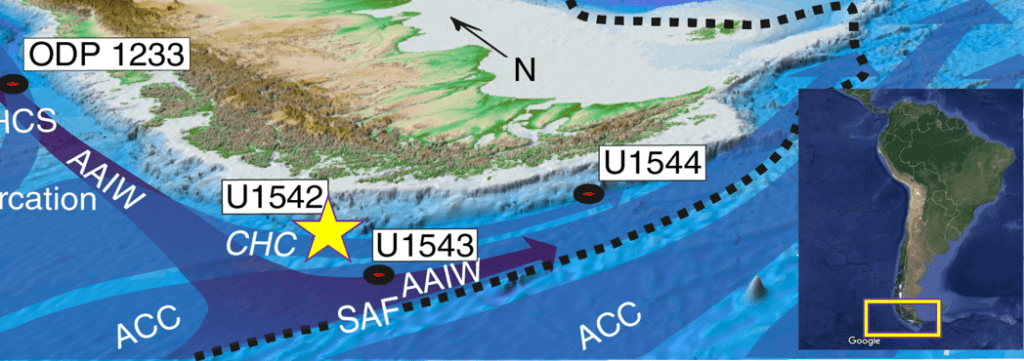
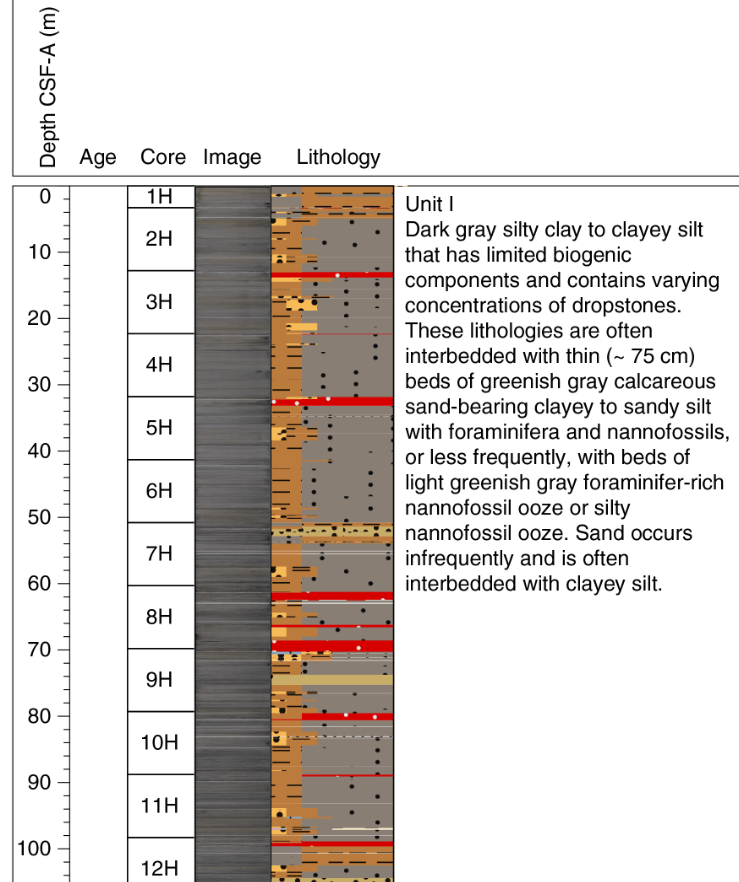
Location and sediment lithology for IODP core U1542
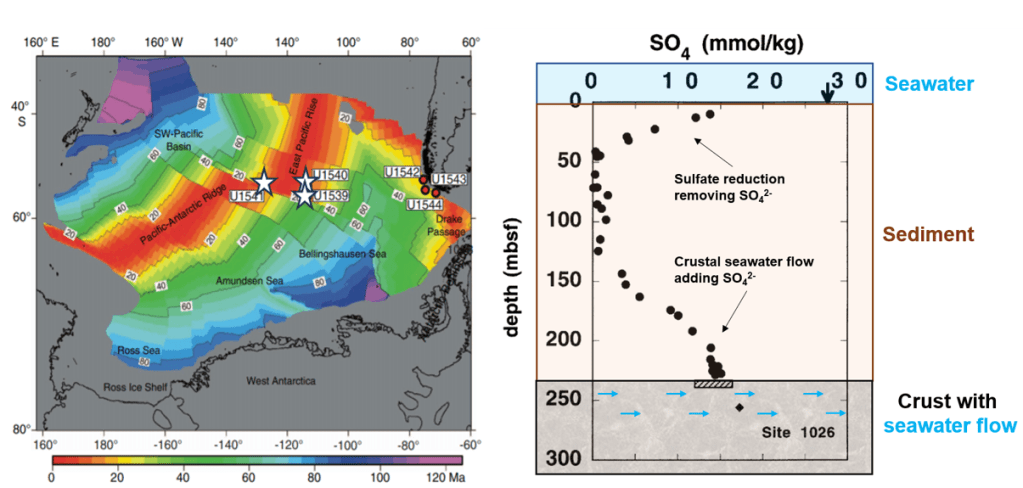
Locations of IODP study sites U1539, U1540, and U1541 (marked in white stars), and example of a gradient reversal in pore water sulfate from the Juan de Fuca Ridge. The arrow on the x-axis indicates seawater sulfate concentration, and the rectangle with hashing indicates the sediment-crust interface. Modified from Elderfield et al., 1999.
Modern Seawater Advection Through Oceanic Crust Below Ancient Marine Sediments
In large areas of the ocean, seawater percolates into exposed basalt along ridges or seamounts and flows laterally through the crust, capped by impermeable sediment. This process is analogous to terrestrial groundwater, and is important in global heat and elemental budgets. However, due to difficulty sampling and observing, this phenomenon is still not fully understood. This project combines new analysis of well-preserved pore water samples from IODP Expedition 383 and mining of legacy pore water data from the IODP database to study a previously unidentified site of cool hydrothermal flow in the South Pacific and create simple diagnostic tools using IODP shipboard data to identify other new sites of cool hydrothermal circulation.
Upcoming projects!
Constraining Benthic Iron Fluxes in the Labrador Sea: Research cruise to the Labrador Sea scheduled for June 2025.
Linked Iron, Sulfur, and Carbon Cycling in Anoxic Fjord Sediments: Sampling expedition to Fiordland, New Zealand planned for Fall 2025.
 Herbert Marine Biogeochemistry Lab